Saturday, July 28, 2012

If you don’t know what a caul is, go ask your mother


Review of The Minister’s Daughter by: Julie Hearn

At long last I’ve returned with a new review for you all. After my review of The Crucible I thought back on reading it in high school. Around the same time I read The Minister’s Daughter by Julie Hearn.

Now, I’ve been ruined by my Education education and as soon as I thought about reading Hearn’s novel I started thinking about supplemental texts (aka the key to any good unit plan).

I’ve always been really curious about the Salem witch trials and love finding fun books that put a new twist on the events. The Minister’s Daughter isn’t about Salem but it carries a lot of the same themes and nicely compliments Miller’s play.

*Summary Contains Spoilers*

The novel opens with the beginning of The Confession of Patience Madden, 1692. She claims she’s finally going to tell the truth about what she and her sister Grace did when they still lived in England.

The story then switches to England in 1645 where we meet our protagonist, Nell. Nell is a Merrybegot (a child sacred to nature who is begot on May Morning) and granddaughter to the cunning-woman and healer of their small village. The cunning-woman is gaining in years and becoming forgetful so she’s teaching Nell the ways of the old knowledge.

Nell speaks with her friend Sam Towser who is madly in love with the minister’s daughter, Grace Madden. Sam tells her the minister has forbidden Maypoles, and frolicking in the woods and fields and any other kind on merry-making on May Morning as it is unholy.

To cut a long story short three important things happen on the eve before May Morning.

1) Nell is summoned by the fairy court to act as midwife for a fairy woman giving birth. She travels under the fairy hill and returns the next morning. The fairies also give her the caul as a gift.

2) Patience Madden, Grace’s younger sister, goes wandering in the night and meets the fairy messenger before he finds Nell. He asks her where the “Mary-by-God” is and poor Patience is convinced she has seen the devil. To add insult to injury she then witnesses…

3) Grace “frolicking” with Sam Towser who Patience is also convinced is the devil.
This eve sets off the rest of the novel told alternately through Patience Madden’s Confession and in the present of 1645.

Grace becomes pregnant and Sam Towser decides to skip town and join the King’s Army because possible death is a better option than marriage. Since Sam is already a dead beat dad Grace goes to the cunning-woman’s cottage to get a purge for the unborn thing. Nell informs Grace that her unborn child is a Merrybegot and it cannot be purged as it is protected by nature.

Needless to say Grace does not take this well. She formulates a plan to get Nell into some trouble and have her accused of witchcraft.

Poor Nell only makes things worse for herself when she tries to protect the baby by tossing a dead frog charm on Grace.

A witch-catcher is called into town and starts gathering evidence against Nell which culminates in the villagers getting caught into the panic and dunking the cunning-woman in the local pond. She doesn’t recover and dies but not before handing her secret box over to Nell. The box contains all her relics of the old knowledge and a little jeweled frog that belonged to Nell’s late mother.

Patience Madden finds out that her late mother had the same jeweled frog.

Yes, the minister’s late wife was also Nell’s mother. Lots of scandal in 1600s England.
Meanwhile, Nell goes for a walk in the woods to ease her grief and finds an injured soldier. She doesn’t know him but the force is strong with this one and Nell’s healer instincts take over. She uses her most precious charm, the fairy caul, and heals the soldier. Nell tells him there’s no need for payment and they part ways.

Flash to All Hallows Eve and the witch-catcher has all his evidence and goes to arrest Nell. She, of course, won’t confess to witchcraft. (Including casting a curse on Grace Madden to make her stomach mysteriously swell.) She is about to be hanged when *drumroll please* the wounded soldier comes back to rescue her!

And to put a cherry on that cupcake, he’s also Prince Charles II of England. Whew.

So our protagonist Nell lives out the rest of her life in happiness and can practice her healing in peace. The minister and his daughters travel to America and settle in…wait for it…Salem!

I must say, Nell’s ending is a little sugary sweet. The history woven into it is kinda cool, (Charles II really was in the part of England where Nell’s village is located in 1645 though the novel is 100% fiction) it is also a little cheesy.

The real good stuff comes with the ending of The Confession of Patience Madden. Patience spends most of the novel as a fly on the wall. She is ignored and called stupid and gets wrapped up in her sister’s scheme to hide her pregnancy. After the Maddens go to America Grace gets married and starts over and Patience becomes a spinster and keeps her father’s home.

Around this time as Patience gains in years Abigail Williams (a character we already love to hate) starts accusing people of witchcraft. Patience is accused and it turns out her Confession is meant to get her out of being tried as a witch.

She goes back to that night before May Morning when Grace was “frolicking” and tells the men her sister knew the devil in the biblical sense and gave birth to his demon spawn.

You see, Grace is the witch so go get her.

Report Card:

The twist Patience Madden’s Confession was just as raw and cold this time around as when I first read the novel. Other than that, I must say, I was a little disappointed with The Minister’s Daughter. It didn’t have the same bite as when I first read it, but for this I have some explanations.

1) When I first read the book I was chin-deep in the Salem witch trials. I absorbed and loved every bit of any type of story that had any remote connection to the period. Hearn’s novel is a really nice supplement to a unit surrounding The Crucible. It is accessible, and it involves really interesting narrative and storytelling devices with the alternating storylines. The novel also gives the readers access into the life and mind of someone who is a little quirky and outspoken and only trying to do the right thing but ends up almost dying because of it. The panic and paranoia motifs run deep.

2) I was 15 when I read this novel. One’s reading of a text dramatically changes over 7 years.     
That being said I will give The Minister’s Daughter my first dual grade—B /C. The B for when I first read it and it made me love learning history and English folklore even more, and the C for when I re-read it and it was a little sugary.

*Note*

For those of you who were worried, Grace Madden’s baby lived. She tried to throw it out in a snowstorm so it would freeze and die, but the boy is a Merrybegot so he was protected and taken in by a kindly village woman and her family. 

Wednesday, June 13, 2012

She turned me into a newt...I got better


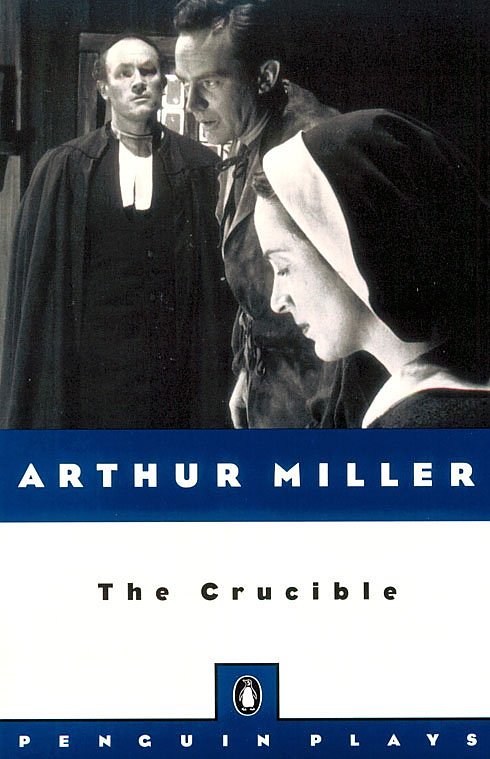
Review of The Crucible by Arthur Miller 

Sophomore year of high school we read a lot plays in which my English teacher always gave himself the best part. He was Oedipus in Oedipus Rex, Agamemnon in The Oresteia, Caesar in Julius Caesar, and of course John Proctor in The Crucible. The Crucible was unique because the cast is big enough that every kid in the class got a part, so over the course of the unit we gave a less than enthusiastic performance and then wrote our papers like good honors English students.

In the time since 10th grade I’ve been surprised at the times when The Crucible comes up in different conversations. I have friends who claim Miller’s play is the worst piece of writing they’ve ever held in their hands, and others who feel the complete opposite. So what kind of play is this that leads to such a varied audience?

*Summary Contains Spoilers*

The story opens in Salem, Massachusetts with the Reverend Parris praying over his sick daughter, Betty. It comes to light that Betty, her cousin Abigail and the other village girls were dancing in the woods with Tituba, a black slave from Barbados. The girls were engaged in some sort of heretic behavior which may or may not have involved voodoo, nudity, animal blood, and spells. Anyways, as they were engaging in such activities Parris stumbled upon the girls and most of them ran but Betty fainted and has been comatose ever since.

Abigail (the ringleader) threatens the other girls and tells them not to reveal what happened in the woods. At this point John Proctor, handsome hero and all-around good guy, enters and asks to speak to Abigail alone.

This is when we find out that our handsome hero and all-around good guy was engaged in an affair with Abigail when she worked at his house a year ago. His wife found out and fired Abigail, which is something the girl has never forgiven, nor has she relinquished her feelings for Proctor. She tries to seduce him in some expertly written colonial dialogue which involves a lot of “I know you!” (in the biblical sense) and comparisons of Proctor to a fine stallion. Being our handsome hero and all-around good guy, he pushes her away telling her to stop being a stupid girl and leave things alone.

Meanwhile, Tituba is accused of witchcraft so she starts accusing others of consorting with the devil. These accusations are something Abigail is all too happy to join in on and soon the now-awake Betty starts in too.

The Reverend Hale arrives as an expert witch hunter and starts “investigating” the goings-on in the town and people are arrested. At this point it becomes clear that there are some rifts in quaint little Salem already. There are arguments over plots of land and money and other things that upset people of young Salem. Not to mention that Abigail is now out for blood since she was rejected by Proctor.

Meanwhile, at the Proctor household, John discusses the arrests with his wife, Elizabeth. As they are the only two who know Abigail’s true nature Elizabeth asks her husband to tell the town the girl is a fraud. He refuses and she accuses him of resuming his affair. Their argument is cut short by their housekeeper girl, Mary Warren, showing up and saying Elizabeth has been accused of witchcraft.

Turns out that in court Mary was sewing a little doll and stuck her needle in the poppet’s stomach so she wouldn’t lose it. Abigail saw her do this and in her infinite wisdom decided to stab herself in the stomach. She tells everyone that Elizabeth Proctor used the doll to conduct her spirit in order to stab her. Elizabeth is arrested as Mary is too afraid of Abigail to actually tell the truth.    

In court, the girls turn on Mary and say that she is bewitching them and there’s lots of yelling. Proctor is furious and admits to his affair and calls Abigail a liar. However, our beautiful heroine and all-around good gal, Elizabeth, says that Proctor was never unfaithful to her in an attempt to save his name. Mary says that Proctor was the one consorting with the devil so our handsome hero and all-around good guy is arrested and, yes, now he is the liar. At this point Abigail steals all of Parris’ money and runs away before everyone can turn on her. Hale, the witch-catcher, also begins to see the error of his ways and starts praying with the people he put in jail and begs them to confess so they can be released.  

Meanwhile, Elizabeth is found to be with child so she is spared. She is sent to talk to her husband and convince him to confess. In a touching scene she forgives him and they renew their love. Proctor says he will sign the confession, but once he finds out it will be nailed to the church door and made a spectacle of he tears the paper to shreds. He then commences to scream “It’s my name!” for several lines. So, instead of chickening out and signing the paperwork Proctor decides to be hanged with the rest of the accused witches.

Report Card:   

The Crucible is an important play and Miller is essential to the American Canon, but it can be a bit difficult to get through. And even though it was slightly obnoxious, I probably wouldn’t remember as much about it if we hadn’t read it all together as a class way back when.

It is really interesting to see how power plays out in The Crucible. Those who seem to hold the most power in the town are those who are persecuted and those who one would think would be the weak and spineless of Salem are the ones who do the accusing and assume all the power. The accusations of witchcraft start with servants and those who have no say in the community, but soon people of influence and landowners are also accused.

Even though Miller has never denied the fiction of the play, his characters are based on the real people who were killed in the Salem witch trials. The play is also a critique of McCarthyism and the communist witch hunt.

I think the “witch hunt” motif is important in any era. We look at the Salem witch trials and the communist witch hunt as if it’s all in past and we are free to critique. But what about the terrorist witch hunts of our post-9/11 world?

As my main man Uncle Ben once said: “With great power comes great responsibility.” And the people of Salem simply weren’t responsible, so let’s learn from them. I give The Crucible a B+.


Thursday, June 7, 2012

And the meek shall inherit the Earth


Review of Anthem by Ayn Rand

I was a late bloomer when it came to Anthem. All the kids in my freshman studyhall read it while I was reading Animal Farm. Why I read Animal Farm before I ever learned the details of the Russian Revolution I shall never know, but while I was rooting for Mollie and her ribbons and crying over Boxer and his work ethic, the others were complaining about Anthem.

It was quite the classic case of “Ms. So-and-soooooooo, why do we have to reeeeaaaad thiiiiissssss?”

Anyways, we were running out of things to talk about in studyhall, I was tired of the complaining, and seriously there was no way I could get them to read Animal Farm. So, I curled up one night with a borrowed copy of Anthem and got to reading.

*Summary Contains Spoilers*

The story opens on Equality 7-2521 (though I shall call him E) who is writing in the solitude of an underground tunnel. He is not supposed to be there as the society he lives in does not believe in individuality and executes those who discover the unspeakable word “I.” Males and females are divided and come together once a year in the mating hall so the society can spawn. The society is also divided by occupation, so all workers of the same job live together and there are strict curfews.

E lives the lowly life of a street sweeper. He and all the other street sweepers live in one house together he discovers that he likes the solitude of escaping to his tunnel. Here he begins to conduct experiments and soon invents a light bulb.

Our protagonist realizes the majesty of his invention and decides he will show it off at the World Council when all the overlord types get together.

Meanwhile E meets Golden One. That’s the name he makes up for her, not knowing her real name. She is a beautiful peasant woman who works in the fields near E’s workspace. One day he chances speaking to her and they fall in instant love.

I understand the love at first sight can leave readers skeptical but the personalities of the main characters lend themselves to it. We already know E is a rebel and turns out that Golden One has the rebellion in her blood as well, and has been watching and thinking about him too.

Of course, based on the rules of the society E and Golden One don’t really know what to call their attraction to each other. They know they feel something similar to that of going to the mating hall but aren’t sure what the feeling is. (*cough cough* lust *cough cough*) They also still aren’t totally aware they are rebels, and E is convinced his light bulb will change the world and benefit the society.

Anyways, one night E leaves the tunnel after curfew and is caught. He’s tortured but won’t admit where he was because he doesn’t want to reveal the secrets of the light bulb yet. E manages to escape and make it to the World Council. Shockingly, they are not impressed with the light bulb and try to kill him for being too individual and inventive and therefore posing a threat to the society.
 
E escapes again and runs deep into the uncharted forest. Golden One follows him and they eventually stumble upon an old house. In the house they find artifacts from the Unspeakable Times and start to learn about life before the society. They finally realize that what they feel for each other is love and vow to be together always. E and Golden One rename themselves Prometheus and Gaia and plan to hunt and work the land. They are going to have children, raise them as individuals, and create a new life where they can say “I” and believe in the power of the ego.

Report Card:

After a night of reading, I finished the book and went to studyhall the next day. Turns out there was still nothing to talk about, because I really enjoyed Anthem.

If you read Anthem I recommend you get the double version that includes the novel as well as the unabridged novel with Rand’s markings on it. It’s fascinating to see the things she changed when editing the book. Sometimes she cuts entire paragraphs and sometimes she only simplifies words. Rand herself is a fascinating character, and the edits are a fascinating look at what she thought of the intelligence levels of the rest of us mere mortals. 

In the end the reader can’t help but root for E as he embarks on a journey of self discovery in one of the most finely-crafted dystopian societies in literature. The dystopian novel has a definite place in today’s English classroom and Anthem is one of the gems of the genre. I give it an A.   


And if that doesn’t convince you, let us not forget Rand’s writing inspired one of the greatest rock albums ever created.

Tuesday, June 5, 2012

You're standing in darker than dark right now


Review of Peeps by Scott Westerfeld

Recently I took a trip to Howe Caverns in New York with my best friend. We took the lantern tour (which I highly recommend) and were deep in the caves where the tour guide turned the lights off and announced:

“You’re in complete darkness right now. No matter how long we stay down here like this your eyes will never adjust.”

At that moment I had two thoughts.

1) JEEPERS CREEPERS TURN THE LIGHTS BACK ON!

2) This would totes not be a big deal if this was Peeps.

Let me begin by saying I wasn’t really looking to read anything by Scott Westerfeld. However, Peeps was recommended to me and I figured it would be a pretty quick read. And then it surprised me.

*Summary Contains Spoilers*

The novel opens on our protagonist, Cal, attempting to wrangle his ex-girlfriend who has become a cannibalistic maniac. Cal is one of the peeps, or someone who is “parasite positive.” He’s immune, but still carries the parasite (in a way not dissimilar to Typhoid Mary) and all his bodily fluids are contagious. Therefore, any girl Cal’s come into any sort of sexual contact with in the year since he became a peep is now a lunatic.

And, we’ll just get it out in the open, yes, they are very much like vampires. Sheesh.

One of the things I appreciated about Peeps was the science laced through the entirety of the book. All of the vampire mythos is explained scientifically. Eating raw meat? The parasite makes a person have heightened adrenaline all the time so they need more food to fuel it. Aversion to crucifixes? The parasite makes people repel what they love (there’s a term for this I don’t recall). So, hundreds of years ago communities were more strongly religious so the peeps hated crosses. The peeps of today are repelled by their favorite songs and even favorite cities (such as New York, NY). 

But back to Cal.

After he was infected and found to be immune and not crazy he was recruited by the Night Watch to help sequester the parasite. Hence, the wrangling of the exes. The Night Watch is centuries old and their job is to try and prevent the spread of the parasite.
A wrench gets thrown in their plan though by families with the “old strain.” That means a strain of the parasite that is just like being a carrier. The gal who Cal cashed in his V-card to, Morgan, is a member of one such family and she purposely tries to infect people. (This becomes clearer in the sequel, The Last Days.)

Cal’s next assignment is to try and find the elusive Morgan.

Joining Cal in his quest is the sassy Lace (short for Lacey). Lace is starting to realize more in going on in the city than meets the eye when she finds a super amazing apartment at a super amazing price. She ends up finding messages scrawled on the walls the landlord tried to cover with paint. Things get stranger when she sees Cal perform a Clark Kent-style leap across apartment balconies. There’s also the undeniable attraction between Lace and Cal but, of course, he can’t touch her because of the whole being contagious thing.

But I promise you this is not a vamp romance novel. Peeps definitely errs on the side of thriller, and when it comes to Lace and Cal you really root for them. They’re two college-aged kids who’ve finally met the right person, finally have something good going for them, and now they can’t even be together. Cal’s straight-man to Lace’s sassiness is funny and true to life. Their dialogue is real and the reader can’t help but cheer them on. I mean, come on, poor Cal’s spent the last year redefining the meaning of “psycho ex.” Boy deserves a chance to settle down.

Of course Cal’s cat comes to his rescue because the disease is also transferred through rats and cats (that’s how it’s traveled and stayed alive for so long). So, one night when Lace crashes in Cal’s living room and cuddles up with his kitty she ends up becoming a peep too. She catches the old strain though so she’s not even mad. Awwww.

To test whether or not Lace is really a peep Cal takes her deep, deep underground through old subway tunnels. That’s right, Cal and Lace go to stand in darker than dark and can see everything as clear as day.
Our dynamic duo, who can finally admit their feelings for each other, go to uncover Night Watch secrets and batten down the hatches against an ancient evil that is about to resurface. And I mean resurface quite literally as there are giant worms living below the earth preparing to end humanity.

The giant worms are explained more thoroughly in the sequel, but honestly The Last Days isn’t as good as Peeps. The story is still interesting but it lacks the snappy narration and the undeniable chemistry between characters. The reader does get a decent crash course in the history of rock ‘n’ roll though.

Report Card:

Hands down the best part of Peeps is the scientific vignettes at the end of each chapter. These describe real parasites in the world today that humans can acquire. Think tapeworm. And then tapeworm x1000. Westerfeld’s author’s note on why he wrote Peeps and why he included the real life parasitic case studies is really interesting and if you read the book I recommend you scope it out.

In a world of sparkly vampires in love triangles Peeps is refreshing and should be read by lovers of most YA genres. And, no, you don’t have to be a young adult to like this book. This would be another great book for some across the curriculum work, and a great independent read. Overall, I give Peeps a B.


And—just in case I ever become a crazed peep—here are some items the Night Watch can use to catch me.